
The Living Breath of Early American Harmony
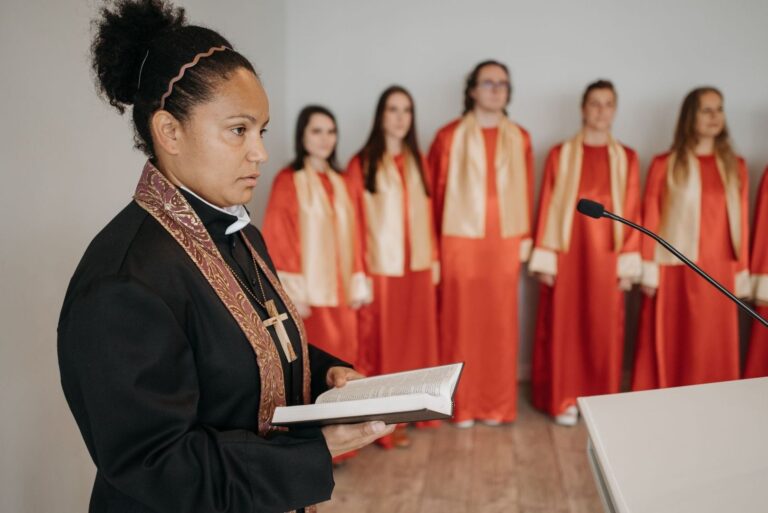
Before organs filled sanctuaries and microphones carried a soloist above the congregation, sacred music often rose on the strength of unamplified human voices. Picture a frontier meetinghouse or a summer camp ground: wooden benches crowded with singers, hymnbooks opened wide, and a first chord gathering in the room like weather. Trebles brighten the upper edge, altos add warmth, tenors press forward with ringing confidence, and basses anchor the entire sound. The result is not delicate or restrained. It is open-throated, physical, and communal, a living wall of harmony in which every singer contributes to the message.
Shape-note singing helped make that sound possible for congregations who had little access to formal musical education. The movement placed practical sight-reading tools in the hands of ordinary farmers, laborers, families, and worshippers across the American frontier. Its four-part arrangements taught singers to listen across the room, hold an independent line, and trust the combined sound. For readers drawn to Southern gospel music, the tradition offers an essential point of origin. The close harmony, sturdy rhythm, and conviction of later gospel quartets did not appear from nowhere. They grew from gatherings where sacred song was learned, led, and carried by the people themselves.
Geometry on the Staff and Music for the Unlearned
Shape-note notation emerged from older European and New England singing practices, but it became distinctly American as itinerant teachers adapted it for rural communities. The best-known early system used four different note-head shapes linked to the solmization syllables fa, sol, la, and mi. A triangle represented fa, a circle sol, a square la, and a diamond mi. The shapes gave singers a visual memory aid, while the syllables helped them understand the relationships among notes before they attached words to the melody.
This approach did not eliminate musical discipline. It redirected that discipline toward a form ordinary people could enter. Conventional staff notation could appear mysterious to a beginner, especially in communities where instruments were scarce and professional instruction was unavailable. Shape notes offered an immediate foothold. A singer could identify a note by its form, speak the syllable, hear its place within the chord, and gradually build confidence through repetition. The Oklahoma Historical Society describes singing schools in which traveling teachers offered intensive evening lessons, often lasting three hours a night for about a month. Such schools transformed musical literacy into a shared local project rather than a privilege reserved for conservatory-trained musicians.
- Fa, sol, la, and mi connected visible shapes with vocal syllables.
- Four-part hymnbooks allowed entire congregations to sing without instrumental accompaniment.
- Traveling singing teachers brought instruction to frontier towns, settlements, and camp meetings.
- Regular practice created both musical skill and a durable network of fellowship.
The spread was rapid because singing schools met several needs at once. They taught reading, supported worship, provided wholesome social activity, and strengthened community identity. Families could attend together, and singers did not need to wait for a trained choir director before participating. Four-part books also encouraged quartet habits, since each part had value and responsibility. The tradition remained especially strong in rural regions of the South, where shape-note books preserved repertory that urban reformers and newer church-music fashions had pushed aside. As the Chorus America overview explains, later recordings and the folk revival introduced this sound to new audiences, but its original power came from direct participation.
Contrasting Classical Rigor with Sacred Harp Realism
European academic choral practice generally emphasized balance, refinement, controlled vocal production, and carefully regulated counterpoint. Those principles could produce extraordinary music, but they also depended on notation, rehearsal systems, and teachers that were not readily available on the frontier. Shape-note singing developed a different kind of rigor. Instead of making the individual voice conform to a polished institutional ideal, it organized many distinct voices into a sturdy collective sound. The singer”s task was to learn the line, project it honestly, and remain connected to the surrounding parts.
Sacred Harp singing made that philosophy audible. In a convention”s hollow square, trebles, altos, tenors, and basses sit on separate sides, facing inward. Singers take turns leading, and the gathering itself functions as performer, choir, and audience. Songs are often sung first on the syllables, then with the text, allowing the architecture of the harmony to ring clearly. The repertoire”s dispersed harmony is especially important: each part behaves like an independent melody rather than a subordinate accompaniment. That independence can produce parallel fifths, hollow fourths, unexpected clashes, and a robust acoustic power that polished choral convention might avoid. Yet the effect is not careless. It is a different aesthetic, one built around immediacy, resonance, and shared responsibility.
| Musical dimension | Academic European model | Shape-note and Sacred Harp model |
|---|---|---|
| Vocal production | Controlled blend and moderated projection | Direct, open, strongly projected tone |
| Notation | Conventional staff notation | Geometric note heads with solmization syllables |
| Leadership | Director-led rehearsal and performance | Rotating song leaders within a hollow square |
| Emotional focus | Refinement, balance, and formal interpretation | Communal conviction, spiritual release, and participation |
This contrast should not be mistaken for a conflict between sophistication and simplicity. Sacred Harp singing requires strong internal hearing, rhythmic steadiness, breath control, and the courage to maintain a part when surrounding voices pull in different directions. Its beauty is physical. The low voices vibrate through the floor, upper parts flash above the texture, and the middle voices create the muscular center of the chord. The result can sound almost ancient and entirely American at once, a style where imperfection is absorbed into fellowship rather than treated as failure. That principle remains relevant to congregations navigating modern worship choices, since collective singing works best when melodies, ranges, and rhythms invite broad participation rather than showcase only exceptional performers.
From Hollow Squares to the Golden Age of Gospel Quartets
The move from shape-note gatherings to gospel quartets was not a simple one-to-one inheritance, but the family resemblance is unmistakable. Shape-note culture normalized four-part singing as a democratic activity and taught listeners to value the individual character of each vocal line. Later gospel groups refined those habits for the stage, the radio, the church program, and the recording studio. The quartet became a compact dramatic unit, capable of shifting from solemn hymnody to rhythmic drive while preserving the emotional force of close harmony.
Traditional shape-note parts also offered a useful foundation for the later gospel arrangement. Treble, alto, tenor, and bass were not copied mechanically into lead, baritone, tenor, and bass roles, but the principles evolved. A lead singer could carry the text with expressive authority, while the tenor added lift above the melody. The baritone filled the crucial inner space, and the bass supplied both harmonic grounding and, in many later styles, a walking rhythmic motion. Gospel quartets added syncopation, call and response, blue notes, hand claps, instrumental backing, and highly individualized vocal color. Still, the central promise remained familiar: four voices could create a complete emotional world when each singer listened carefully and served the whole.
- Shape-note schools established four-part literacy among broad rural populations.
- Church and community singing made harmony a shared social expectation.
- African American spiritual traditions introduced intensified rhythm, call and response, and expressive vocal inflection.
- Country gospel and Southern quartet music adapted these resources into portable, memorable arrangements.
- Radio and recordings carried the sound into a national golden age of gospel quartet performance.
The cross-pollination was complex and deeply American. African American spirituals, worship practices, shape-note repertory, and country gospel traditions developed within different communities and historical circumstances, including the profound realities of slavery, migration, segregation, and religious resilience. They nevertheless met through churches, conventions, publishing networks, local performances, and commercial recordings. Scholarship on nineteenth-century music, including work collected by the Society for Christian Scholarship in Music, shows how sacred and secular traditions continually exchanged forms, memories, and expressive ideas. American gospel emerged from that circulation, preserving the old value of communal harmony while giving it new rhythmic urgency and theatrical energy.
Preserving the Fellowship of Pure Acoustic Voice
Sacred Harp singing remains resilient because it is more than a repertory. It is an event structure designed to welcome participation. Modern singings generally have no audience seating and no protected performance platform. Singers form the hollow square, choose parts, and take turns leading songs, often without lengthy rehearsals. Beginners can join, make mistakes, and learn by remaining inside the sound. The Sacred Harp Musical Heritage Association documents a living tradition that now reaches far beyond its Southern origins, attracting people of varied religious affiliations, ethnic backgrounds, and nationalities.
That breadth is significant in an age of digital fatigue. Much contemporary music is consumed privately, compressed through earbuds, edited into perfect takes, and measured by individual attention. An unamplified singing convention offers the opposite experience. The sound cannot be separated from the bodies producing it. Breath, room, wood, and human timing all matter. A missed entrance may be heard, but it is quickly surrounded by other voices. The singer is neither an isolated consumer nor a passive audience member. Participation becomes the point, and the acoustic resonance creates a form of fellowship that technology cannot fully reproduce.
- Choose melodies with accessible ranges and rhythms that a congregation can sustain.
- Teach difficult passages through syllables or repeated vocal patterns before adding the full text.
- Give singers permission to project freely while maintaining healthy breath support.
- Rotate leadership so musical responsibility belongs to the whole group.
- Value listening across the ensemble more than individual volume or display.
Everyday worship groups can draw practical lessons from the early singing masters. Strong communal tone begins with preparation, but it does not require uniform voices. It requires clear entrances, disciplined vowels, reliable pitch centers, and an understanding of how each part supports the message. Directors can also protect the spiritual purpose of singing by selecting texts that express shared truths and melodies that welcome more than the strongest musicians. In this setting, excellence is not the same as polish for its own sake. It is the careful craft that allows a congregation to sing with confidence, emotional honesty, and lasting encouragement.
Carrying the Resonant Spirit into Tomorrow
Shape-note singing transformed American sacred harmony by lowering the doorway into musical participation without lowering the value of musical craft. Geometric notation helped rural singers read, singing schools built confidence, and four-part hymnbooks established a culture in which harmony belonged to the entire congregation. From the hollow square came a durable vocabulary of independent lines, rich chords, strong bass movement, and vocal commitment. Those elements later helped shape gospel quartets and the broader American language of sacred popular music.
The enduring invitation is simple and demanding: make room for every voice, then teach every voice to listen. Modern choirs can honor the tradition through accessible repertoire, rotating leadership, unamplified singing, and a renewed respect for the emotional power of a shared chord. When singers stand together with clear purpose, the result is more than a technically accurate performance. It is a living declaration of faith, fellowship, and human dignity. The sacred chord continues to transform because it asks no one to remain silent. It calls every willing singer to enter boldly, carry the line, and help the whole assembly rise.